

 Česky (CZK)
 Deutsch (EUR)
 Polski (EUR)
 Français (EUR)
 Español (EUR)
 Italiano (EUR)
 Română (EUR)
 Ελληνικά (EUR)
 Dutch (EUR)
 Eesti keel (EUR)
 Português (EUR)
 Magyar (EUR)
 Svenska (EUR)
 Dansk (EUR)
 Suomen kieli (EUR)
 български език (EUR)
 Slovenščina (EUR)
 Slovensky (EUR)
 lietuvių kalba (EUR)
 latviešu valoda (EUR)
 Norsk (EUR)
 Hrvatski (EUR)
 українська мова (EUR)
 Tiếng Việt (CZK)
 Türkçe (EUR)
 Malti (EUR)
 日本語 (にほんご) (EUR)
 Bahasa Indonesia (EUR)
 српски језик (EUR)
 ქართული (EUR)
 Íslenska (EUR)
New synthetic drugs in Europe
- New substances are added every year
- Synthetic stimulants
- Synthetic opioids
- New psychedelic drugs
- Other experimental psychoactive substances
- Conclusion
- FAQ
Abbreviations used in the article:
- EUDA: European Union Drugs Agency
- EMCDDA: European Monitoring Centre for Drugs and Drug Addiction
- NPS: New psychoactive substances (drugs)
- EU: European Union
- CNS: Central nervous system
New substances are added every year
In Europe, new substances were monitored by the EMCDDA until 2024, which was replaced by the EUDA on July 2, 2024. The new name reflects the agency's broader mandate—in addition to monitoring, it now actively supports member states in addressing drug issues, for example through early warnings about new substances or harm reduction strategies.
In Europe, over 950 new psychoactive substances (NPS) were monitored at the end of 2023. In 2024, there were a total of approximately 1,000 NPS.
Monitoring of completely new drugs in Europe (originally EMCDDA, now EUDA):
- In 2016–2022, there were around 50 per year
- In 2023, 26 were recorded
- In 2024, 47 were monitored
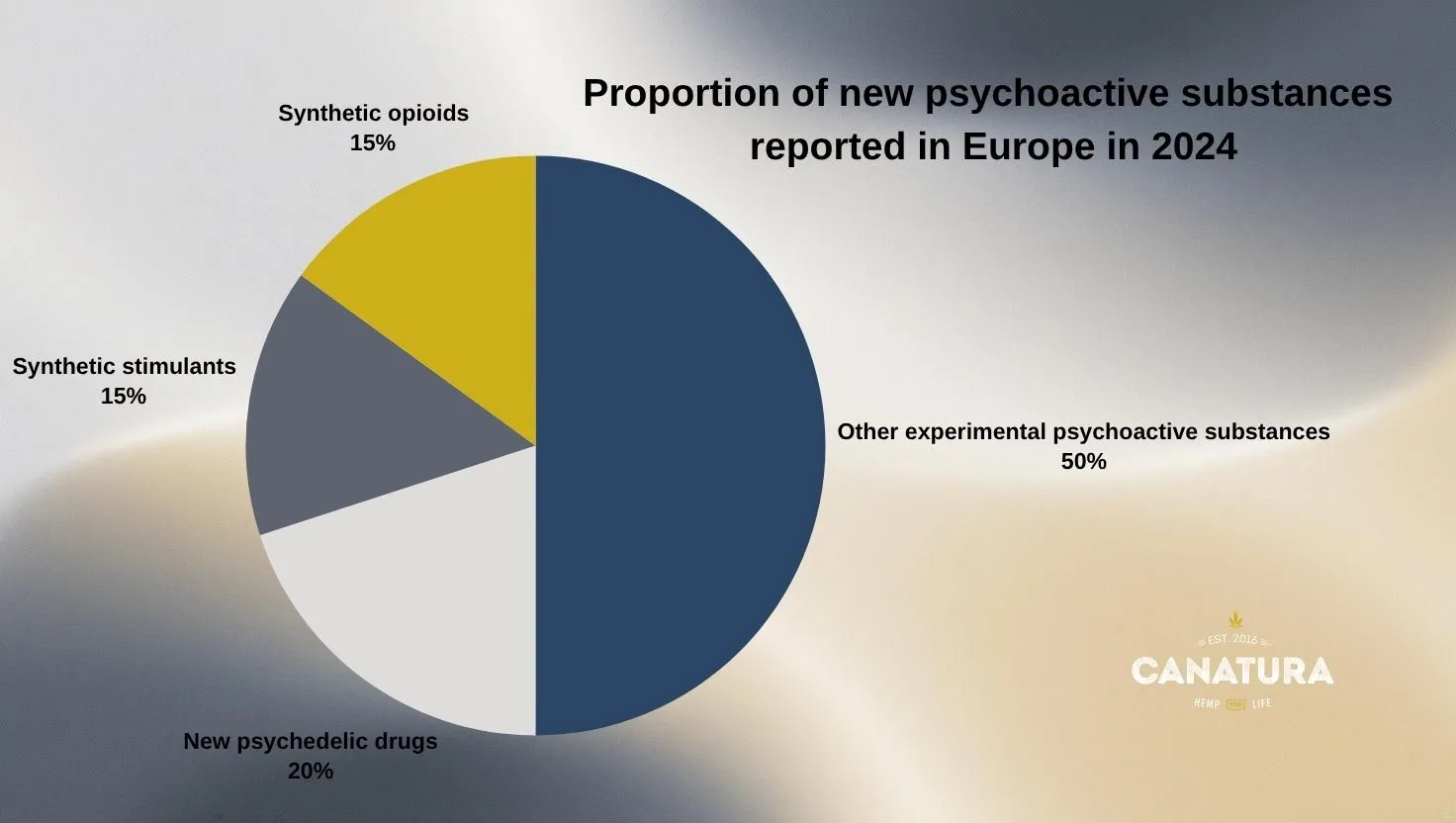
Proportion of new psychoactive substances reported in Europe in 2024 by type (estimate based on EMCDDA data): The largest share (~50%) is accounted for by other experimental psychoactive substances, followed by new psychedelic drugs (~20%), synthetic stimulants (~15%) and synthetic opioids (~15%).
European Commissioner Ylva Johansson said in a presentation to the EU Drugs Agency in 2024 that "criminals are constantly creating new drugs to avoid detection. Last year, these were mainly nitazene, highly potent and extremely lethal substances that caused deaths in Estonia and Latvia and poisoning in Ireland and France."
This trend has also hit the Czech Republic with alarming force. The National Drug Headquarters (NPC) recently warned of new synthetic drugs on Czech territory – the first illegal lab producing the new stimulant drug clefedron has been discovered, there have been several overdoses of new synthetic opioids, and two people have died from their effects.
Synthetic stimulants
Synthetic stimulants are a group of substances that are manufactured to mimic the effects of classic stimulants such as amphetamines, MDMA, or cocaine. This category includes synthetic cathinones (known as "bath salts" or "drug salts") and other stimulating substances.
The EUDA report indicates that synthetic cathinones are a growing problem in Europe. They are smuggled in large consignments from India and are now also being produced locally, mainly in Poland.
In 2023, four new synthetic cathinones were among the newly reported NPS in Europe, which are also beginning to appear in ecstasy tablets as substitutes for MDMA.
Clephedrone (4-CMC, 4-chloromethcathinone)
Clephedrone is a chlorinated derivative of mephedrone. It comes in the form of a fine yellowish crystalline powder that is snorted or swallowed.
Clephedrone has been monitored in Europe for several years, but has only recently come to wider attention due to large-scale production in Central Europe.
This substance is most commonly found in clubs and at festivals and has recently become one of the most talked about stimulants.
Other new stimulants
Other synthetic cathinones detected recently include:
- N-ethyl-norpentedrone (also known as NEP)
- Dipentylon (a derivative of pentylon)
- New variants of 3-CMC/2-MMC (replacing 3-MMC)
These stimulants are appearing in some European countries in ecstasy tablets or in mixtures sold as cocaine/MDMA, which users are mostly unaware of.
Synthetic opioids
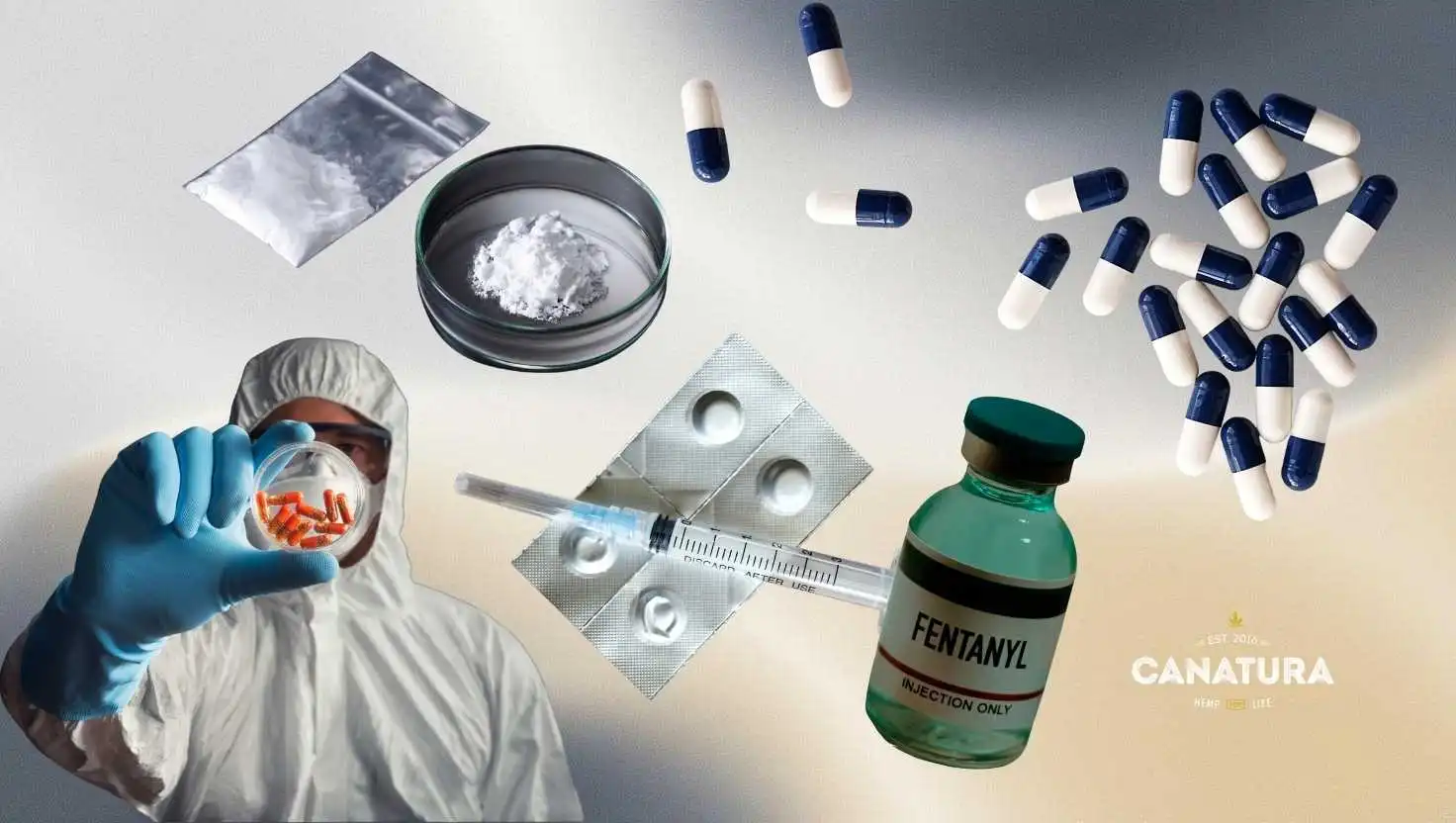
Synthetic opioids are the most dangerous new category of synthetic drugs. These are extremely potent substances with effects similar to heroin or fentanyl. Although they are not yet as prevalent in Europe as in North America, they are on the rise, particularly in the Baltic States.
A total of a record 9 new synthetic opioids were reported in 2023, reflecting manufacturers' attempts to fill the gap in the event of a shortage or lack of heroin or pharmaceutical opioids.
Nitazenes
Nitazenes were originally developed in the 1950s as potential analgesics, but due to their extreme potency and low therapeutic potential, they were never used in medicine.
These are substances such as isotonitazene, metonitazene, and protonitazene.
According to experts, some nitazenes can be up to 100 to 1,000 times stronger than morphine.
Nitazenes are currently under scrutiny in the EU; the European Commission proposed regulating them in 2023, and several countries have already banned them through national regulations.
Spirochlorphine (R-6890, slang: "spirochlorfin")
Spirochlorphine was first mentioned in research in the 1970s and has recently reappeared as a "research chemical" (a new, little-studied psychoactive substance sold online or on the black market under this label to avoid legal regulation). It was first reported to the international system in 2024 and subsequently appeared in the US and Europe.
It is a synthetic opioid from the group of brorfine analogues (spiropiperidines). According to experts, it is probably five times stronger than fentanyl, i.e. about 25 times stronger than heroin. It is therefore one of the strongest known opioids.
New psychedelic drugs
In recent years, the number of completely new hallucinogenic psychoactive substances has decreased slightly, but some new ones have appeared on the market.
Manufacturers offer substitutes for classic hallucinogens, such as lysergamides (LSD derivatives) or new phenethylamines similar to 2C-B, which are designed to circumvent bans.
New psychedelic drugs and dissociative anaesthetics include:
- New lysergamides (LSD analogues): modified LSD molecules sold as "legal LSD", e.g. 1P-LSD, 1B-LSD, 1cP-LSD and, more recently, 1V-LSD (valerylated LSD)
- Synthetic tryptamines and phenethylamines: although completely new series have not appeared in recent years to the same extent as before, the following have been monitored: 5-MeO-DMT derivatives (powerful hallucinogens from toad secretions, now synthetic), new NBOMe substances applied to paper as a substitute for LSD, and 2C-B-FLY (a specific bicyclic hallucinogen).
- New dissociatives (ketamine/PCP analogues): substances on the borderline between hallucinogens and sedatives, e.g. diphenidine and ephenidine (ketamine substitutes discovered around 2013) or "designer PCP" (phencyclidine) substances such as 3-MeO-PCP, 3-MeO-PCE, 2F-DCK.
Other experimental psychoactive substances
Highly potent substances related to medicines or substances from other drug scenes are also appearing on the European market.
New psychoactive substances found in Europe in 2024/25 include:
- 7-hydroxymitragynine (7-OH tablets – kratom extract)
- New benzodiazepines
- Tianeptine (an antidepressant with opioid effects) – mainly in the US, so far only marginally present in Europe
- New "smart drugs" or stimulants such as 2-FMA and 3-FEA (amphetamine derivatives sold online as study aids or weight loss drugs)
- Gabapentin or pregabalin (anticonvulsants, not NPS) – used recreationally in combination with opioids to enhance the effect
7-hydroxymitragynine (7-OH tablets – kratom extract)
Although the kratom alkaloid 7-hydroxymitragynine (7-HMG) is not a synthetic drug in the true sense of the word, as it is a natural metabolite of the kratom plant, it is available on the market in a highly concentrated synthetic form – with approximately four times the potency of opioid receptors.
Kratom (Mitragyna speciosa) primarily contains the alkaloid mitragynine, which has weaker opioid effects. Mitragynine may have addictive properties and there is a very high risk of dependence with use, as reported in animal studies.
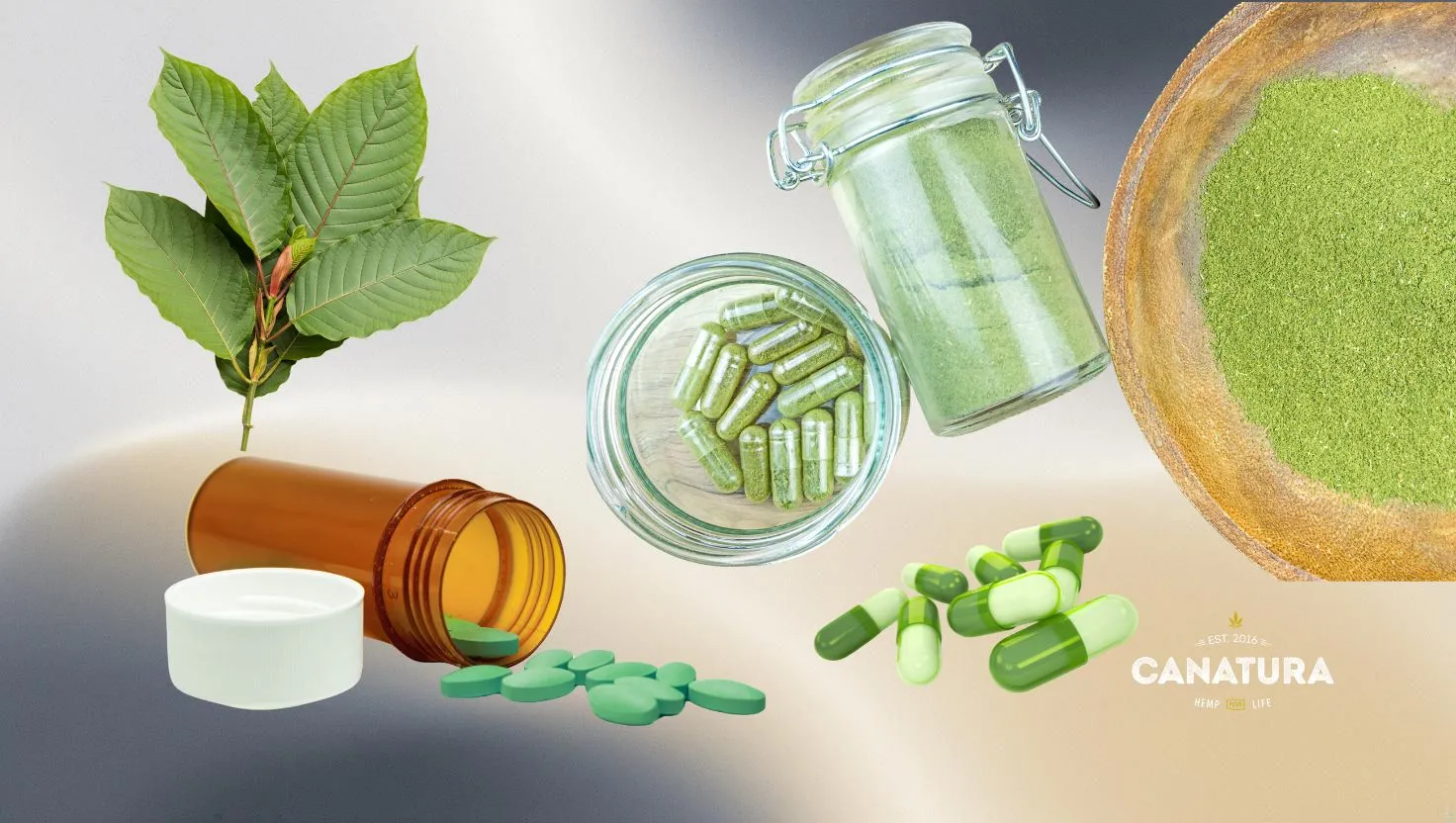
7-OH tablets or drops resemble kratom products, but the reality is different – they contain unnaturally high doses of 7-HMG, a semi-synthetic derivative of the alkaloid mitragynine (7-hydroxymitragynine), which is many times stronger than kratom itself and can cause strong psychoactive effects and a risk of addiction.
Experts warn that it is necessary to distinguish between natural kratom and these concentrated extracts. Unfortunately, sellers sometimes deliberately confuse the two.
There is ongoing debate in the EU about whether 7-HMG should be classified as a controlled opioid. Dr. Paula N. Brown stated at a symposium in February 2025 that "synthetic 7-OH is not kratom—it is a highly potent, unregulated chemical."
New benzodiazepines
New benzodiazepines (designer sedatives) and similar sedative substances are usually sold online as substitutes for medications for anxiety or sleep. In Europe, for example, etizolam, bromazolam, flualprazolam, clonazolam and others have appeared.
These substances are typically characterized by strong CNS depressant effects (similar to diazepam or alprazolam), but are not approved as medicines – they were developed as "research chemicals."
These substances are gradually being banned; in recent years, the EU has added some to its lists, such as etizolam in 2021.
Conclusion
Since 2024, new synthetic drugs have been emerging across various categories in Europe. The greatest concern is raised by synthetic opioids, particularly nitazene and other extremely potent substances, which have already led to several fatal overdoses in EU countries.
Synthetic stimulants such as cathinones are gaining ground on the dance drug scene. New hallucinogenic psychoactive substances are emerging less frequently, but there is still an active market for LSD analogues and other psychedelics.
The situation is further complicated by new experimental substances, such as synthetic extracts from kratom, which straddle the line between legal and illegal drugs.
FAQ
1. What are new synthetic drugs (NPS) and why are they dangerous?
NPS are chemical compounds that mimic the effects of known drugs with many times greater intensity, but have a modified chemical structure to evade legislative control.
They often appear in unknown mixtures or are added to other drugs (ecstasy, MDMA, cocaine), their effects are unpredictable, and users usually have no idea what exactly they are taking. This increases the risk of overdose and other health complications.
2. Which groups of synthetic drugs pose the greatest threat in Europe?
Currently, synthetic opioids are considered the most dangerous, mainly nitazenes and, more recently, spirochlorphine, which can be many times stronger than heroin.
Synthetic stimulants such as clephedrone are also on the rise, and new hallucinogens are emerging, including substitutes for LSD and ketamine.
New experimental drugs such as 7-OH tablets, which contain unnaturally high levels of the kratom alkaloid 7-hydroxymitragynine (7-HMG), also pose a major risk.
3. What are the possible scenarios for the development of the drug situation in Europe in the coming years?
If the availability of traditional drugs such as heroin is restricted (e.g. due to the geopolitical situation in Afghanistan), it can be expected that newly emerging synthetic substances (especially opioids) will fill this gap. This could lead to a dramatic increase in deaths, similar to what happened in the US with the spread of fentanyl.
4. Is there a risk of a "fentanyl scenario" in Europe like in the US?
Yes, there is a risk. If synthetic opioids such as fentanyl or nitazene become more widespread, this could lead to a sharp increase in fatal overdoses.
For this reason, it is crucial that Europe does not relax its monitoring and is prepared to respond in a timely manner.
5. What helps reduce the risks associated with synthetic drugs?
There are three key pillars:
- Ensuring the availability of naloxone: Naloxone is a drug that can reverse opioid overdoses (e.g., fentanyl) in some cases and can save lives.
- Drug testing: For example, through drug-checking services (common at festivals in the Netherlands and Belgium). This allows users to know what a substance actually contains and can prevent them from taking an unknown dangerous substance or overdosing.
- Education: Clear information about risks, dosages, and first aid so that users can make safer decisions.
Generic bans are also being introduced at the national level to prevent manufacturers from easily circumventing the law by changing the molecule.
Sources:
- euda.europa.eu
- euda.europa.eu/news/2024/7/european-drug-report-2024-highlights
- euda.europa.eu/publications/european-drug-report/2024/new-psychoactive-substances
- euda.europa.eu/publications/european-drug-report/2024/synthetic-stimulants
- drogy-info.cz/nms/o-nas/system-vcasneho-varovani/synteticke-katinony-v-mdma/
- unodc.org
Author: Patricie Mikolášová
Photo: AI
"All information provided on this website, as well as the information provided through this website, is for educational purposes only. None of the information contained herein is intended as a substitute for medical diagnosis and such information is not to be considered medical advice or recommended treatment. This website does not promote, endorse or advocate the legal or illegal use of narcotic drugs or psychotropic substances or the commission of any other illegal activity. Please see our Disclaimer for further information."