Česky (CZK)
 Deutsch (EUR)
 Polski (EUR)
 Français (EUR)
 Español (EUR)
 Italiano (EUR)
 Română (EUR)
 Ελληνικά (EUR)
 Dutch (EUR)
 Eesti keel (EUR)
 Português (EUR)
 Magyar (EUR)
 Svenska (EUR)
 Dansk (EUR)
 Suomen kieli (EUR)
 български език (EUR)
 Slovenščina (EUR)
 Slovensky (EUR)
 lietuvių kalba (EUR)
 latviešu valoda (EUR)
 Norsk (EUR)
 Hrvatski (EUR)
 українська мова (EUR)
 Tiếng Việt (CZK)
 Türkçe (EUR)
 Malti (EUR)
 日本語 (にほんご) (EUR)
 Bahasa Indonesia (EUR)
 српски језик (EUR)
 ქართული (EUR)
 Íslenska (EUR)


Is white label the right choice for your business?
- What is white label?
- Advantages of white labelling
- How does white labelling work?
- When and for whom does white labelling make sense?
- White label vs. customized products
- How does white labelling work here at Canatura Wholesale?
- Is white label the right choice for your business?
- FAQ
What is white label?
White label is a business model whereby you utilise an existing product manufactured by another company and market it under your own brand.
Such a white label product is manufactured by another company, whilst you give it its own identity – a name, logo, label and packaging.
Manufacturers offering white label services often have a special category on their online shop dedicated to products designed specifically for this type of collaboration, or they may set out the terms and conditions for white labelling directly on their website.
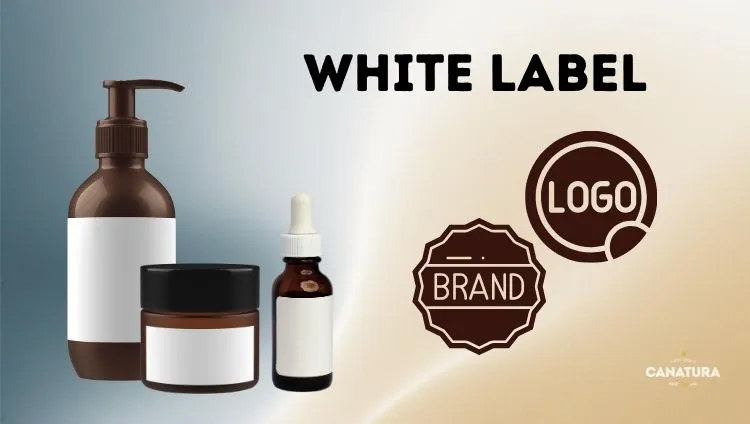
You then agree on specific terms with the supplier, such as quantity, packaging and branding options.
You then offer the resulting product to customers as your own-brand product – with your own name, logo and packaging.
Advantages of white labelling
One of the main advantages of white labelling is the ability to expand your portfolio with a new product without having to develop it from scratch.
You simply apply your own label to the product, or send the supplier your graphic design files and have them apply the labels (if they offer this service). You can then put the products on sale straight away.
Other benefits of white labelling include:
- lower initial investment – you do not need to invest in product development and manufacturing,
- faster time-to-market – you’re using an existing product, so part of the development and testing process is eliminated,
- more scope for other activities – instead of manufacturing and development, you can focus on sales, distribution, brand building and customer relations,
- creating your own brand without the hassle – you offer the product under your own logo, label and packaging,
- easier to expand your product range – you can test a new product category without major disruption to your existing operations.
How does white labelling work?
The principle of white labelling is relatively simple. A manufacturer offers a finished product, which another company includes in its range under its own brand.
As a retailer working with the manufacturer who supplies the product to you, you will need to agree on matters such as:
- the quantity of product to be purchased,
- whether you will provide the labelling yourself or supply it to the manufacturer, who will then take care of everything for you,
- the price and terms of the order,
- delivery times and method of transport,
- and, where applicable, the available documentation and laboratory analyses for the product.
When and for whom does white labelling make sense?
White labelling may not be the right solution for every business. It depends on:
- how quickly you need to bring the product to market,
- how much control you want to have over its composition and specifications,
- how important it is for you to stand out from the competition.
White labelling makes particular sense where speed, simplicity and your own branding are priorities, whilst developing your own product is not essential.
This model is also popular, amongst other things, in sectors where product development and manufacturing are technologically complex. It is precisely here that collaboration with an established manufacturer can significantly simplify market entry or the expansion of an existing product range.
White label vs. customized product
The difference between a white-label and a customized product lies primarily in the degree of customisation.
With both options, you use an existing product from another company, which you launch under your own brand, but:
- whilst with white labelling only the name, label, packaging and, where applicable, other branding elements are changed, and the product itself remains the same,
- with a customized product, as the name suggests, there is scope to modify the product itself.
Depending on the manufacturer’s capabilities, a customized CBD oil, for example, can be customised in terms of concentration, carrier oil, terpenes or bottle size. This option usually requires more time to prepare and may involve a higher minimum order quantity or higher initial costs.
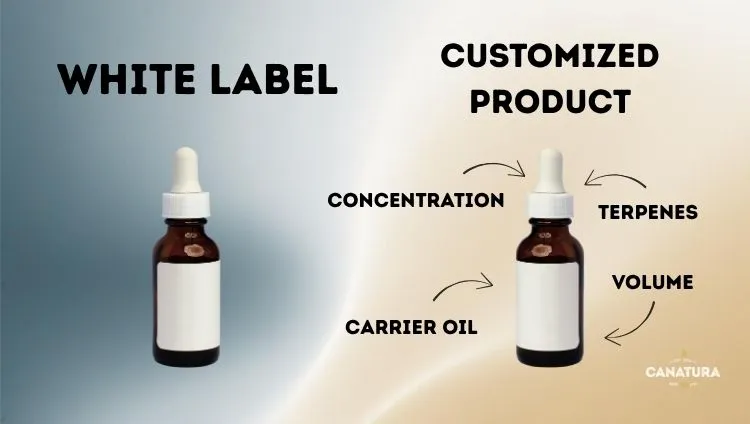
White label therefore makes sense if you want to expand your own-brand portfolio more quickly without altering its contents.
Whereas a customized product is more suitable when it is more important for you to tailor the product to your requirements – and thus stand out more from the competition – yet you do not wish to invest in in-house development.
Tip: You might be interested in finding out how to find a quality and reliable CBD supplier.
How does white labelling work here at Canatura Wholesale?
At Canatura Wholesale, we have a wide range of products available for white labelling, and we handle each order individually according to the customer’s requirements.
First, we’ll work with you to clarify exactly which product you’re interested in, its specifications, the required quantity and the design of the final packaging. Based on this information, we’ll prepare a personalised quote for you.
The whole process usually proceeds as follows:
- you tell us your ideas and requirements,
- we’ll clarify the product’s specifications together,
- we’ll prepare a personalised quotation,
- once approved, we’ll create an order and finalise the graphic design of the product packaging,
- once payment has been received, we’ll send the order to production.
The production of white-label products at Canatura Wholesale takes approximately 1–3 weeks, depending on the type of product and the current workload of the production and printing facilities.
Are you interested in a white-label product under your own brand? Contact us at [email protected]. We’d be happy to discuss the options and terms of cooperation with you.
Which white-label CBD products can I order?
Other white-label products we offer
- White label CBG
- White label CBN
- White label CBC
- CBDP white label
- HCT white label
- THCX White Label
- THC+ white label
- THCV White Label
- H4CBD White Label
- CBG9 White Label
- HHCPM White Label
Is white label the right choice for your business?
White label can be a suitable solution if you want to expand your product range with products under your own brand, but do not want to or cannot invest in their development.
It allows you to utilise an existing product and focus primarily on sales and building your own brand.
Before making a decision, however, it is worth considering how much customisation suits your needs and which parts of the process you want to handle yourself. If you do not need a unique product and an existing product under your brand is sufficient, then go for white labelling.
If, on the other hand, you need to adjust the product’s composition or specifications and still lack the resources for development, then a customized product will be more suitable for you.
FAQ
1. Who is white labelling suitable for?
White labelling can be suitable for online shops, retail outlets and start-up brands that want to expand their range with their own products without having to develop them from scratch.
2. Do I have to sort out my own label for a white-label product?
It depends on the specific supplier. You may have to apply the label to the supplied products yourself, but with some manufacturers, you can provide a graphic design for the label and they will take care of everything for you.
3. What is a white-label product?
A white-label product is an existing product that you can market under your own brand and name.
The product itself is manufactured and supplied by another company, whilst you offer it with your own logo, label and packaging. The supplier may also provide the same or a very similar product to other online shops.
4. What is the minimum order quantity for white-label partnerships?
The minimum order quantity varies depending on the supplier and the specific product. You should therefore check the terms and conditions directly with the company in question.
Photo: AI, Canva
"All information provided on this website, as well as the information provided through this website, is for educational purposes only. None of the information contained herein is intended as a substitute for medical diagnosis and such information is not to be considered medical advice or recommended treatment. This website does not promote, endorse or advocate the legal or illegal use of narcotic drugs or psychotropic substances or the commission of any other illegal activity. Please see our Disclaimer for further information."